Research
We examine how children learn to interpret others' behavior: their goals, intentions, and emotions. We analyze how children increasingly better predict others' actions and build more complex understanding of social relationships.
We study how infants communicate before words appear: through gaze, facial expressions, gestures, and vocalizations. We are interested in how early signals give rise to turn-taking in interaction, joint attention, and first "conversations" with caregivers.
We are interested in what makes children initiate and maintain social contact and how they learn to cooperate with others. We study the development of coordination in joint activities (e.g., role division, action adjustment) and factors that facilitate effective cooperation.
A longitudinal study on the development of preverbal communication and cooperation in infants aged 7-13 months. We use observational methods. Contact us if you would like to participate.
Every study in our laboratory takes place in a friendly and safe atmosphere. Our "laboratory" is simply a cozy playroom, additionally equipped with cameras recording the session. Before the study begins, parents receive clear information about its purpose and course, and have the opportunity to ask questions.
All studies are approved by the Ethics Committee of the Faculty of Philosophy at JU. After the visit, children receive a small gift, and parents receive compensation (if provided by the project) and a commemorative video of selected session fragments showing developmental changes in their child.
Sign up for research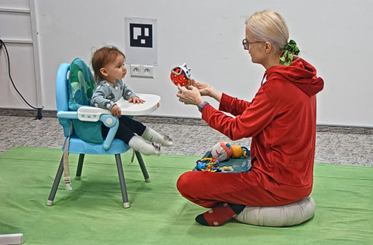
We are looking for parents with children of various ages. Contact us to learn more about current projects and sign up for a study.